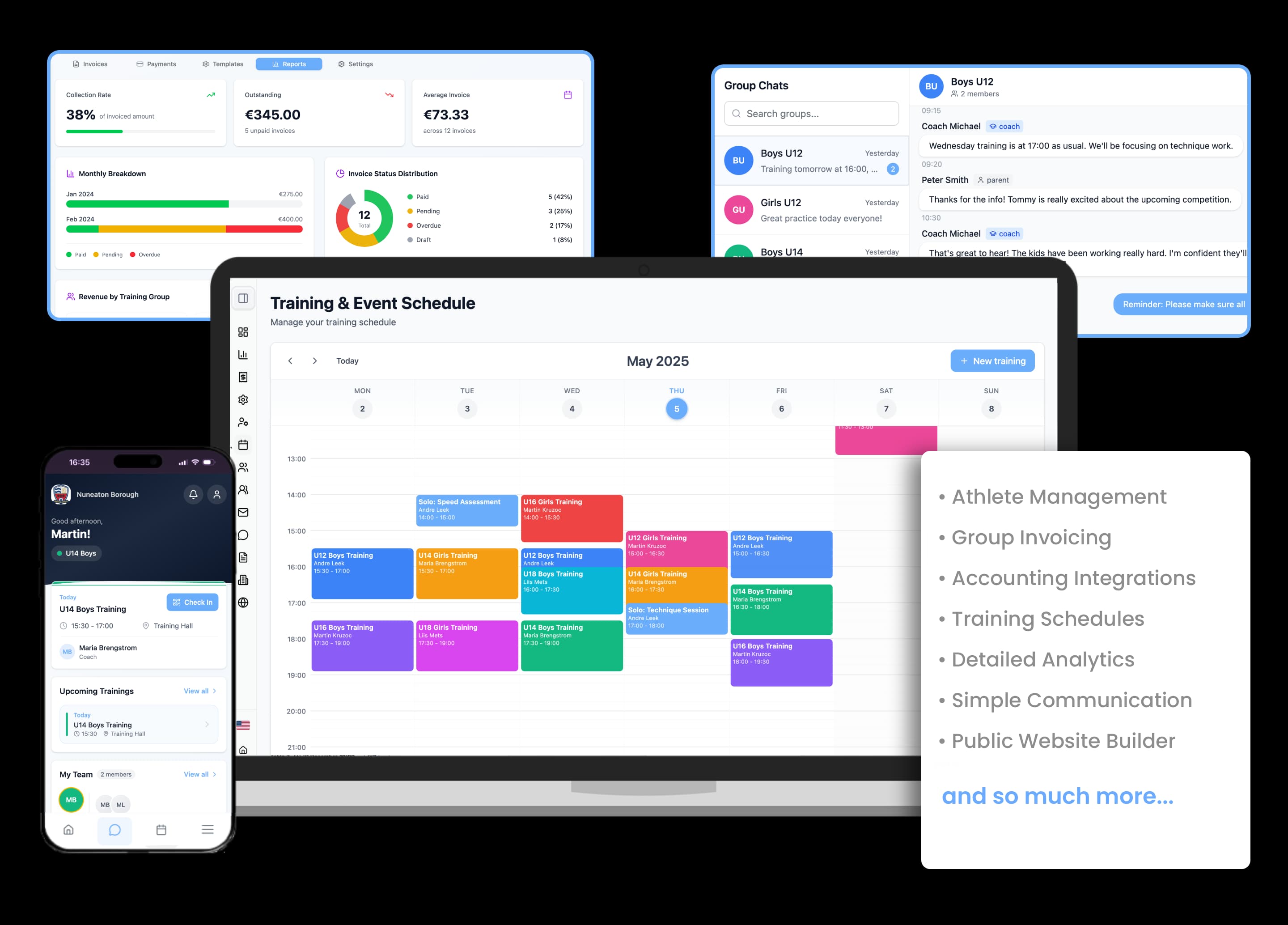
Sports club billing you set up once
Membership fee collection without the busywork: you create each group's fee rules once, Klubio builds the invoices, sends them out and ties incoming payments to the right child by reference number. You only review the exceptions.
14-day free trial · No credit card required

Everything membership billing needs
Bill by month, quarter or season
The billing cycle can be monthly, quarterly, per semester or yearly. Pick the one your club already runs on.
Reference numbers & auto-matching
Every athlete has a permanent reference number, so a payment finds its own invoice, even when a parent pays for two children at once.
Bank statement import
Import an SEB, Swedbank or LHV statement, or any bank's CAMT.053 file.
Debtor overview & reminders
Outstanding amounts are grouped by age: up to 30 days, 31–60, 61–90 and over 90. Reminders go out from that list in a couple of clicks.
Discounts that cover real life
Family discount by child position, age-based pricing, tag-based exceptions and a payment pause during an injury: all in the rules, not in your head.
Card payments & bank links
A parent pays straight from the invoice by bank link or card. The money lands on the club's account and the invoice is marked paid without you.
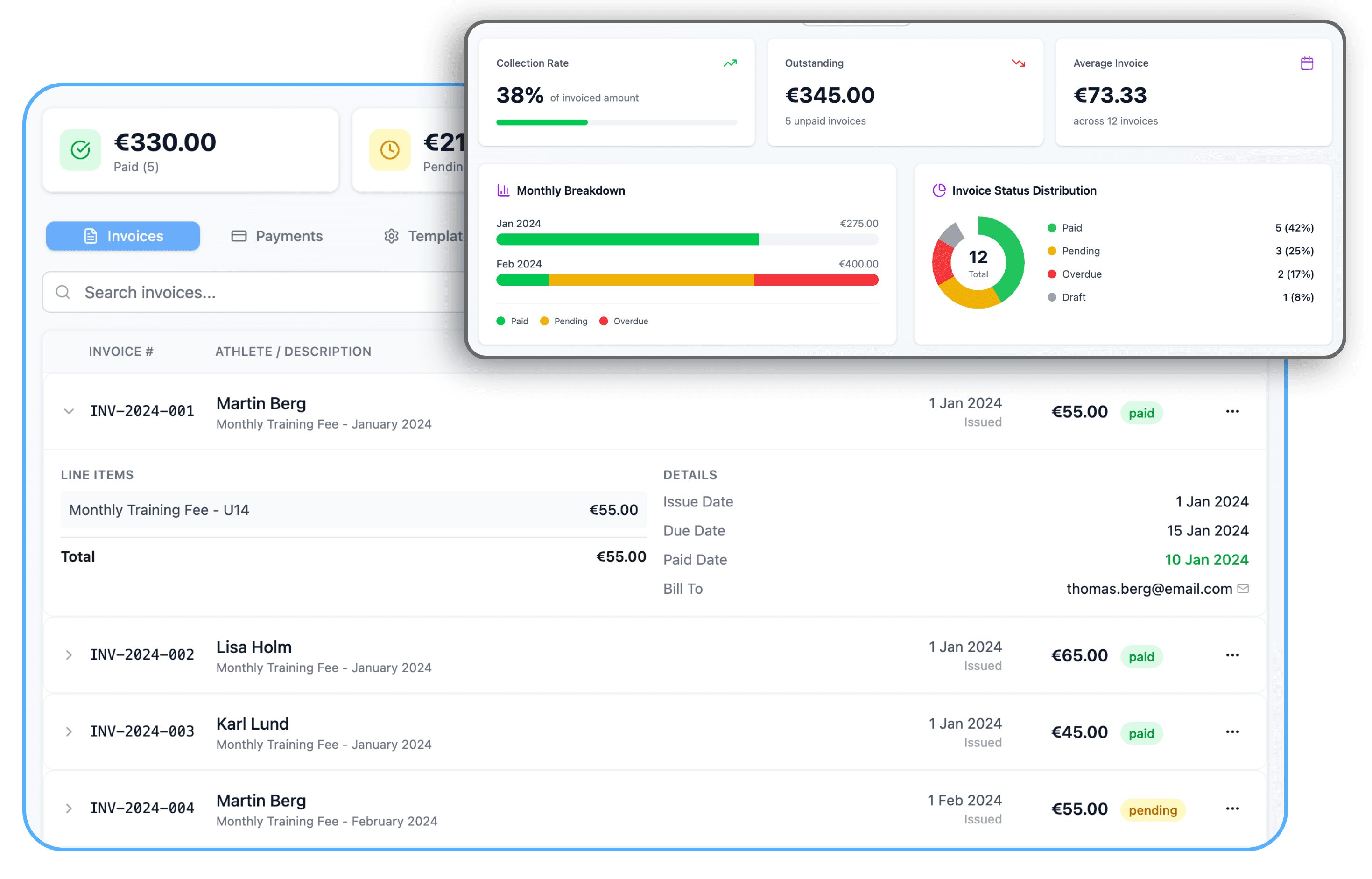
This is what billing looks like in Klubio
Issued invoices, what has been paid and who still owes all sit on one dashboard. This is the real Klubio billing view, not an illustration.
How Klubio invoicing actually works
Club billing is never “one price for everyone”. In a real club, groups have different fees, some kids train in two groups, families have several children, and someone is always paused with an injury. Klubio's billing is built for exactly that complexity: you create the rules, the system produces the invoices.
Billing plans attached to groups
Billing starts from a plan attached to a training group. The plan sets the fee model: a flat fee of, say, €45 a month, an attendance-based fee of, say, €8 per session, or a combination of the two. The same plan sets the billing cycle, which can be monthly, quarterly, per semester or yearly. On the attendance model you also choose what counts: attendance the coach marked, the athlete's own sign-up, or every session that was on the plan. A plan can also carry a fixed extra line, such as the club membership fee or insurance, which is added to every invoice automatically.
Rules that cover the exceptions
An attendance-based fee can have an upper limit. You can put it on the number of sessions, for example up to 12 sessions a month, or on the amount, for example no more than €60 a month. The family discount follows child position, and you decide which sibling counts as the first. Usually the most expensive invoice stays at full price and the discount lands on the cheaper ones. Age can be used to step the price, so the youngest groups pay less. Special cases marked with a tag, such as a coach's child or a supported family, get their own rule. When a child is out injured, you set a payment pause and no invoices are created. When an athlete trains in several groups, you decide whether the base fee is charged once or per group.
From reference number to accounting
Every invoice carries a reference number that ties the payment to the right invoice. You just import the bank statement. Unpaid invoices collect in the debtor view by age: up to 30, 31–60, 61–90 and over 90 days. If the club uses Merit Aktiva, Excellent Books, SmartAccounts or SimpleBooks, invoices and payments flow there on their own.
A tennis club with three groups
Picture a tennis club with a competitive group, a recreational group and mini-tennis classes. In Klubio it looks like this:
- Tennis A (competitive): flat €65/month, invoice goes out automatically on the 1st of every month.
- Tennis B (recreational): €8 per session, capped at €60/month, so frequent players never pay more than the flat rate.
- Mini-tennis (ages 4–6): €35/month with a family discount where the second child gets 20% off and the third 50%.
- An injured player: payment pause for two months; no invoices are created and nothing needs cancelling later.
At the start of the month a hundred invoices go out automatically, reference numbers match the payments by themselves, and the club manager only reviews the debtor list.
How it works
Set your billing rules
Pick a fee model, billing cycle and discounts for each group.
Klubio invoices
Invoices are built and sent on the day you choose.
You see the whole picture
Collection rate, average days to pay and debt by age bucket on one dashboard.
Frequently asked questions
Do invoices really go out automatically?
Yes. Each group carries a billing plan that sets the fee model and the cycle. Klubio builds and sends the invoices from there on its own. Payment pauses and discounts are applied as it goes, so there is nothing to review each month.
How are payments matched to invoices?
By reference number. You import a bank statement and Klubio ties the payments to the right invoices and marks them paid. Prepayments carry through to your accounting as well.
Which banks does Klubio work with?
SEB, Swedbank and LHV statements import directly. We also support CAMT.053 (ISO 20022), which every bank can export, so billing doesn't depend on where the club banks.
Can parents pay by card?
Yes. Invoices carry a payment link for bank-link or card payment. The money lands on the club's account and the invoice is marked paid automatically.
How complicated can the discounts get?
The family discount follows child position, for example the second child at 20% less and the third at 50% less. You decide whether the child on the most expensive or the cheapest invoice counts as the first. On top of that you can step pricing by age, attach an exception to a tag, for example a coach's child pays nothing, and pause payments during an injury.
Other features
- Accounting integrationTwo-way sync with Merit Aktiva, Excellent Books, SmartAccounts and SimpleBooks. Invoices and payments move on their own.
- Members & groupsYour whole membership, training groups, applications and contracts in one database.
- Schedules & attendanceTraining calendar, attendance marking and shared schedules for coaches.
- App for parents & athletesSchedules, invoices and notifications in the iOS and Android app, with the whole family on one account.
- Public club websiteA public club page, registration forms and a schedule widget for your own website.
Run your club the smarter way.
Join clubs who've ditched the spreadsheets and brought their operations into one modern platform.